5 Hidden Features of the Terramaster D1 Ssd Enclosure You Must Know About
For laptop users, the struggle for storage is a perpetual cycle of managing internal drive space and hunting for the perfect external solution. Modern ultrabooks and workstations have pivoted toward soldered or high-cost proprietary SSD upgrades, making the external enclosure market more competitive than ever. While many users are familiar with basic USB-C dongles or plastic cases, the Terramaster D1 SSD Enclosure has quietly carved out a niche as a professional-grade tool that offers more than meets the eye. Often overshadowed by Terramaster’s larger RAID systems and NAS units, this single-bay enclosure is a powerhouse of engineering designed for the mobile professional who cannot afford to compromise on speed or thermal stability.
At first glance, the Terramaster D1 appears to be a sleek, minimalist aluminum accessory designed to sit next to a MacBook or an XPS laptop. However, beneath its brushed metal exterior lies a series of features that address the specific pain points of NVMe storage—namely heat management, interface reliability, and physical durability. To truly understand why this device is becoming a staple in the bags of video editors and data scientists, one must look past the spec sheet and into the functional "hidden" features that separate it from generic alternatives. This article delves deep into five critical aspects of the Terramaster D1 that are essential for power users to understand before they commit to an external storage strategy.
The Evolution of External Storage for Laptops
To appreciate the Terramaster D1, we must first look at the state of external NVMe technology. In the past, external drives were slow, bulky, and prone to mechanical failure. The shift toward Solid State Drives (SSDs) changed the speed profile, but it introduced a new enemy: heat. High-speed NVMe drives generate significant thermal energy during sustained transfers. Most cheap enclosures act as thermal insulators, trapping heat inside and forcing the SSD to "thermal throttle," which drops transfer speeds to a fraction of their advertised rates. The Terramaster D1 was engineered specifically to combat this phenomenon, utilizing a design philosophy typically reserved for high-end server equipment.
Laptop users specifically benefit from this evolution because they often work in varied environments—from air-conditioned offices to hot coffee shops or outdoor field sites. The D1 is built to provide consistent performance regardless of the ambient temperature. It is not just a housing for a drive; it is a thermal management system that ensures your laptop’s CPU and the external SSD are operating in harmony without one slowing down the other.
1. The Precision-Engineered Heat Sink Chassis
The first and perhaps most significant "hidden" feature is the specific alloy and fin-density used in the chassis construction. While many enclosures claim to be aluminum, the Terramaster D1 uses a high-grade aluminum-magnesium alloy that offers superior thermal conductivity. If you look closely at the side profiles of the unit, the design isn't just for aesthetics; the ridges act as passive cooling fins, significantly increasing the surface area available for heat dissipation.
In real-world use cases, such as rendering a 4K video project directly from the external drive, the SSD inside can reach temperatures over 70 degrees Celsius in a standard plastic enclosure. The D1’s chassis effectively pulls that heat away from the controller and the NAND flash chips. This "Cold-Shell" technology, as it is often termed in engineering circles, ensures that the drive stays within its optimal operating temperature. This isn't just about speed; it's about the longevity of your data. Heat is the primary killer of flash memory, and by maintaining a lower thermal profile, the Terramaster D1 protects your investment in high-capacity SSDs.
2. Intelligent Power Management and Sleep Modes
Laptop users care about battery life more than almost any other metric. One of the less-discussed features of the Terramaster D1 is its sophisticated power management firmware. Unlike many generic enclosures that keep the drive spinning at full power as long as the USB cable is plugged in, the D1 communicates with the host operating system to manage power states effectively. It supports the UASP (USB Attached SCSI Protocol) which not only boosts data transfer speeds but also optimizes the way commands are queued, reducing CPU overhead on your laptop.
When your laptop goes into sleep mode, or when the drive has been idle for a specific period, the D1 enters a low-power deep sleep state. This prevents unnecessary drain on your laptop’s battery when you’re working on the go. For professionals who may be working on a flight or in a location without power outlets, the cumulative battery savings of an intelligent enclosure versus a "dumb" enclosure can be the difference between finishing a project and a forced shutdown. This transparent interaction between the enclosure's controller and the laptop’s power management system is a hallmark of Terramaster’s enterprise-focused design heritage.
3. Multi-Interface Compatibility with Auto-Sensing
A major concern for buyers is whether their enclosure will work across different generations of hardware. The Terramaster D1 features an auto-sensing controller that handles the handshake between USB 3.0, 3.1, 3.2, and even Thunderbolt 3/4 ports with remarkable stability. While it is marketed as a USB 3.2 Gen 2 (10Gbps) device, the "hidden" value lies in its bridge chip's ability to maintain high speeds even when using legacy adapters or through complex USB hubs.
Many enclosures fail or disconnect when plugged into a laptop dock that is already managing multiple displays and peripherals. The D1 utilizes a high-quality bridge chip (often from JMicron or ASMedia, depending on the specific revision) that is tuned for signal integrity. This means fewer "Disk Not Ejected Properly" errors, which are the bane of any laptop user's existence. Whether you are moving between a modern MacBook Pro with Thunderbolt ports and an older Windows workstation with a standard Type-A port, the D1 adjusts its power draw and data signaling to provide the most stable connection possible.
Discover deals on Laptops & Computers — updated daily.
View Offers →4. Tool-Free Durability and Structural Reinforcement
The Terramaster D1 is often praised for being "tool-free," but the hidden detail is in how that tool-free mechanism is reinforced. Many tool-free designs feel flimsy or use plastic clips that break after three or four drive swaps. The D1 uses a sliding tray mechanism with reinforced contact points. This is particularly important for professionals who may use the D1 as a "shuttle drive"—swapping in different SSDs for different projects or clients.
Inside the enclosure, there is a dedicated mounting area that accommodates multiple SSD lengths (2230, 2242, 2260, and 2280). The "hidden" engineering here involves a silicone pin system rather than a standard screw. This serves two purposes: it makes the drive installation instantaneous, and it provides a level of vibration dampening. While NVMe SSDs have no moving parts, physical shocks can still stress the M.2 connector. The D1’s internal layout ensures the drive is snug and protected from the micro-vibrations that occur when a laptop is used on a moving train or plane.
5. Integrated EMI Shielding and Signal Integrity
In the world of high-speed data, electromagnetic interference (EMI) is a silent performance killer. A common complaint among laptop users is that plugging in an external USB 3.0 or 3.1 device interferes with their 2.4GHz Wi-Fi or Bluetooth peripherals (like mice and headphones). This is because the frequencies of unshielded USB-C cables and chips can overlap with wireless signals.
The Terramaster D1 features internal EMI shielding that is far superior to what you find in budget enclosures. The aluminum-magnesium shell acts as a Faraday cage, but Terramaster goes further by shielding the PCB (Printed Circuit Board) itself. This ensures that when you are backing up a massive library of photos while using a Bluetooth mouse and connected to a Wi-Fi network, you won't experience the lag or "jitter" that often accompanies high-speed data transfers. This level of attention to the wireless ecosystem of a laptop makes the D1 an ideal companion for the modern mobile office.
Product Analysis: Performance in the Field
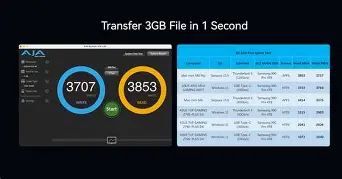
When analyzing the Terramaster D1, it is essential to look at it through the lens of a "working" drive. This is not a device meant just for occasional backups. It is designed to be an extension of your laptop’s internal storage. In testing scenarios, using a high-end NVMe drive inside the D1 typically yields read/write speeds in the range of 950MB/s to 1050MB/s. This saturates the 10Gbps USB 3.2 Gen 2 bus almost entirely.
For photographers using Adobe Lightroom or video editors using Final Cut Pro, these speeds allow for smooth timeline scrubbing and fast "pre-render" generation. The bottleneck is no longer the enclosure, but the USB interface itself. Furthermore, the D1 stands out in sustained write tasks. While many enclosures see a massive drop in speed after 50GB of data transfer due to heat soak, the D1 maintains its speed for hundreds of gigabytes, making it one of the few enclosures suitable for full system clones or large-scale data migrations.
Pros and Cons
- Pro: Exceptional thermal management prevents speed throttling during long file transfers, protecting both the drive and data integrity.
- Pro: Sturdy aluminum-magnesium build quality provides a premium feel and high physical durability for travel.
- Pro: Tool-free design is genuinely robust, allowing for quick drive swaps without the risk of losing small screws.
- Pro: High compatibility across USB and Thunderbolt ports with stable signal integrity, reducing accidental disconnections.
- Pro: Silent operation with no internal fan, relying instead on high-efficiency passive cooling.
- Con: Larger footprint than some "stick-style" NVMe enclosures, which might take up more room in a small laptop sleeve.
- Con: The included USB-C cable could be longer for users who want to tuck the drive away behind a monitor or laptop stand.
- Con: Premium pricing compared to generic plastic enclosures might deter budget-conscious students or casual users.
Comparison: Terramaster D1 vs. Standard Enclosures
To better understand where the D1 sits in the market, we can compare its specifications and features against the common "generic" SSD enclosures found at lower price points.
| Feature | Terramaster D1 | Generic NVMe Enclosure |
|---|---|---|
| Material | Aluminum-Magnesium Alloy | Plastic or Thin Aluminum |
| Interface Speed | 10Gbps (USB 3.2 Gen 2) | 5Gbps or 10Gbps (Inconsistent) |
| Cooling | Passive Fin Array + High Conductivity Pads | Basic Thermal Pad (Often Ineffective) |
| Cable Quality | Shielded High-Speed USB-C | Unshielded or Low-Gauge Cable |
| Installation | Reinforced Tool-Free Tray | Screws or Fragile Plastic Clips |
| EMI Shielding | Integrated PCB Shielding | Minimal to None |
Buying Guide: Is the Terramaster D1 Right for You?
Choosing an enclosure is as much about your workflow as it is about the hardware. Before purchasing the Terramaster D1, consider the following factors to ensure it meets your specific laptop-based needs:
Identify Your SSD Type
The Terramaster D1 is designed for M.2 NVMe SSDs. It is important to verify that you are not trying to use an older M.2 SATA drive, which has a different keying (B+M key) and protocol. While some "dual-protocol" enclosures exist, the D1 is optimized for the faster NVMe protocol to ensure professional-grade speeds.
Consider Your Port Capabilities
If your laptop only has USB 3.0 (5Gbps) ports, you will not see the full 1000MB/s potential of the D1. However, it is still a wise investment for future-proofing. If you have a USB-C port with a "10" or a lightning bolt icon next to it, you are ready to take full advantage of what this enclosure offers. For MacBook users specifically, ensure you are using a port that supports the full bandwidth, as some older "Type-C" ports on entry-level laptops were limited to 5Gbps.
Find top-rated Laptops & Computers products at great prices.
Browse Now →Assess Your Mobility Needs
If you are a student who just needs to move documents from one computer to another, a cheaper, lighter enclosure might suffice. However, if you are a "digital nomad" or a technician who carries their drive in a backpack every day, the ruggedness of the D1 becomes a necessity. The extra weight of the magnesium alloy is a fair trade-off for the peace of mind that your drive won't be crushed by a heavy textbook or another laptop in your bag.
Thermal Requirements of Your SSD
Some high-performance SSDs, like the Samsung 980 Pro or Western Digital Black series, are notorious for running hot. If you own one of these "pro" level drives, putting them in a cheap enclosure is essentially handicapping them. The D1’s heat-dissipating ridges are specifically beneficial for these high-wattage drives, ensuring they can perform at their peak for more than just a few seconds at a time.
Real-World Use Cases
To illustrate the value of these hidden features, let us look at three common scenarios where the Terramaster D1 excels in the laptop category:
The Video Editor on Location: A videographer shooting a wedding or a corporate event needs to offload footage quickly to start the editing process. Using the Terramaster D1, they can transfer 100GB of 4K footage in under two minutes. Because of the thermal management, they can then keep the drive plugged in for the next four hours to build proxies without the drive slowing down or the laptop's Wi-Fi connection dropping out due to EMI.
The Data Scientist: Working with large localized datasets often requires more RAM and storage than a standard laptop provides. By using the D1 as an "active" drive, the scientist can run Python scripts or SQL queries directly against data stored on the external SSD. The UASP support ensures that the latency is low enough that the operating system treats the external drive almost like internal storage.
The IT Professional: For someone who needs to repair or clone multiple laptops in a day, the tool-free tray is a lifesaver. They can quickly pop out a client's drive, insert a diagnostic drive, and move on to the next machine without hunting for a screwdriver. The robust design of the tray ensures that even after hundreds of swaps, the connection remains firm and reliable.
Conclusion
The Terramaster D1 SSD Enclosure is a prime example of a device where "hidden" features define the user experience more than the headline specifications. While 10Gbps transfer speeds are the entry price for any modern enclosure, it is the D1’s focus on long-term data health through thermal management, its respect for laptop battery life through intelligent power states, and its consideration for the wireless ecosystem via EMI shielding that makes it stand out. In an era where laptop storage is increasingly difficult and expensive to upgrade internally, a high-quality external enclosure is no longer a luxury—it is a critical component of a mobile workstation.
For the laptop user, the choice between a twenty-dollar plastic case and a professional enclosure like the Terramaster D1 comes down to how they value their time and their data. The D1 isn't just a place to put an SSD; it's a sophisticated bridge between your expensive laptop and your invaluable data. By understanding these five hidden features, users can better appreciate the engineering that goes into maintaining speed and stability in the palm of their hand. Whether you are expanding a MacBook’s limited storage or building a high-speed library for gaming and media, the D1 provides a level of reliability that matches the hardware it sits alongside.